
A.I. Troubles In College Level Classrooms
Troubles of AI in the Classroom. (Image has been generated by AI)
This blog is about my [Nathan Misener’s] experiences with AI use in my Canadian College level programming classes.
It was the Fall of 2023 and my semester just started. I was teaching a database class online, an in-person 3rd term C++ class and a first semester Web class. I was not prepared for what was going to happen that semester.
Much like many of my colleagues A.I generated work really took us by surprise. At that point it was new to most of us, and we really did not have policies in place for it so that semester was a mad scramble to patch up our classroom against the flood of AI submitted work.
My View
I really do not think students should be using it. I may sound like a grumpy old man, shaking my fist, but hear me out first.
Why Do Student’s Use AI?
I did a brainstorm with my class to find out why students use Generative AI to complete their work.
What most of the topics boiled down to were:
· Lack of understanding of the subject
· Not enough time to complete their work/poor time management
· Pressures to be perfect/get good grades
· Just wanting to pass
· It is easy to use
There were more, but these were the most repeatedly said items.
Many students would get in the cycle of poor time management, which leads to not giving themselves enough time on a project, which leads to errors in their code and not enough time to learn proper coding techniques which finally leads them to copying the assignment into ChatGPT (or other AI) and getting immediate results.
Why Is This Bad?
A.I. is not perfect. It missed context of questions, and can respond back with incorrect code, improper techniques or at least not following the class standard, and most important of all a failure on the student to learn.
I myself use AI for writing assignment instructions, but I have to apply so many revisions and quality checks that I am not sure if its worth it overall.
Why Is It a Bad Learning Tool?
It is not, its actually a great tool for learning and debugging…but you need to know how to use it and learn from it first.
Why I do not want it used in my classrooms are because AI is too willing to give code first over learning explanation. It would be similar to being stuck on a bug or problem and you either have:
Someone help guide you to an answer, by providing resources that you can use to fix it yourself
Or
Someone fixing the problem for you.
One of these solutions leads to a great learning experience and one does not.
A.I. does the latter.
When learning, there is a process. One visual example of this process is “Kolb’s Learning Cycle”
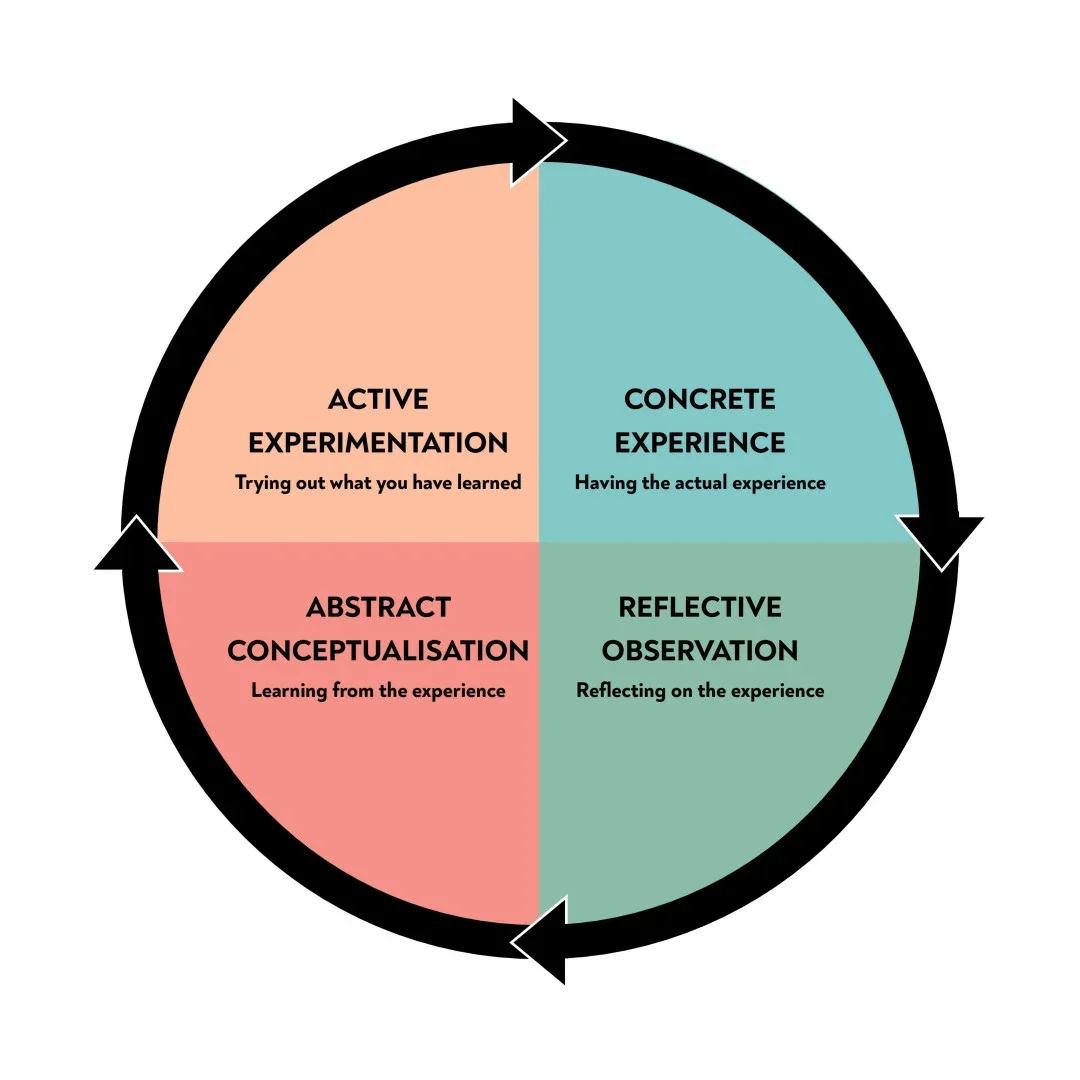
A.I. and Kolb’s Learning Cycle
If you have not looked at Kolb's Learning Cycle, it discusses Experiential Learning. How your experience helps you learn.
It simplified learning into 4 stages.
1. Concrete Experience: Where you take in and assimilate information. (like learning in a lecture)
2. Reflective Observation: Where you think critically of and process the information you received. (this can also be reviewing your work)
3. Abstract Conceptualization: Formulating and thinking about the application of the information you have used.
4. Active Experimentation: This is you using what you have learned and applying the skills to complete a problem.
When A.I is used, you miss some of the steps of this cycle, therefore destroying your active learning pattern.
The stage that is frequently missed is the “Active Experimentation”. Since a student generally will try to do an assignment themselves, however when they get stuck, that is when A.I. is frequently used, to help solve the problem.
Most of the time when I have caught a student submitting code that was generated, the biggest tell is sitting them down in front of their code and discussing it with them. I try to rename some of the functions, swap the order of code and remove comments from the submitted scripts. Generally when asking about their methodology for doing a task they will not have a good answer, or they will usually come clean, I usually say “It is OK to say, ‘I don’t know’” to give them an out.
The act of using the knowledge and problem solving is what makes you desirable by a company. It is the journey of problem solving, not the end result which makes you a good learner.
Detecting A.I. In Student Submissions
This is a difficult task when it comes to programming, especially in an introductory course.
For code, this is a bit trickier since detectors are not quite there to detect code.
I usually take my assignment and generate 5-7 instances of it through A.I. and try to look for common patterns between them.
This usually includes things that were not covered yet in class, if you are on a beginner topic, but they use advance techniques to solve it, I would investigate further.
Common generated comments on the code.
Naming convention of variables.
But also student ability, if they are terrible on tests but their assignments are flawless there may be something more to it.
Preventing A.I.
In short, you cannot.
Day one of my classes we discuss my A.I. policy for the class, and I physically get them to sign a copy of the Policy Agreement. This way they know and have agreed to not using A.I.
In tests, try physical test. That way they cannot use online tools. If your test is online, try getting a lock-down browser to only allow them access to the test. And ensure cell phones are put away in their bags or handed in to you. Please note that this will not stop the people who want to cheat. I have had many students hiding phones under their seats and using them when I am at the other end of the room (Mind you I also allow students to bring study sheets).
Growth Mindset and A.I.
One issue discussed above is that students generally will want to pass a course. Unfortunately, when a student starts falling behind, it is hard for them to catch up. This is where they will get into a bad cycle of A.I. reliance. They use A.I. to complete a project, they fail that project, then they worry about failing so they use A.I. to get a perfect mark on the next project.
This becomes a fixed mindset for the student, believing they cannot change or fix their current situation.
Try to ensure you have a ladder built in place to help these struggling students back out of the A.I reliant hole they are in.
I utilize a handwritten research paper that a student must complete before resubmitting a new version of their work.
Conclusion
I cannot stop the use of A.I. but I can throw some hurdles at it and try to make learning the easier path.
A.I. is a big issue for new learners as it is too ready to complete the work for you rather than helping you learn. It takes away from the Active Experimentation section of Kolb’s Learning Cycle. Finally it causes a negative learning cycle that students get stuck in, relying on it as a crutch for hard work.
I would very much like to hear your thoughts and successes in your classroom, or your experience using A.I.
References:
https://www.youtube.com/watch?v=MMB1bRYcU8c
https://citt.ufl.edu/resources/the-learning-process/types-of-learners/kolbs-four-stages-of-learning/
Original blog was cross posted with permission from Nathan Misener. Here is the original post.